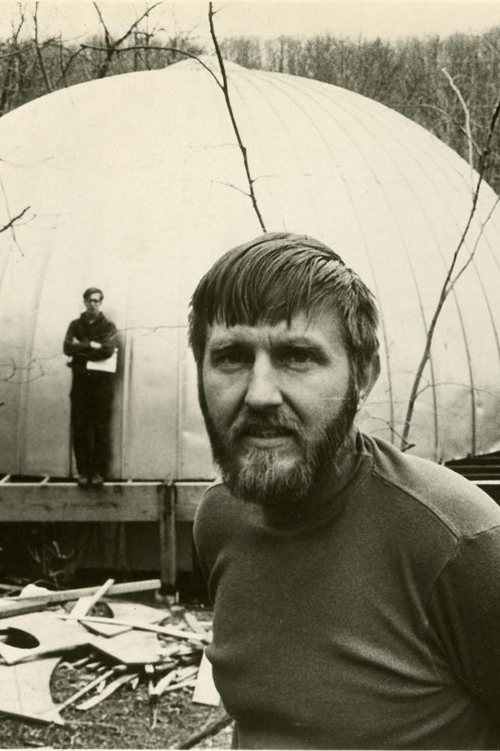
Stan VanDerBeek
Biography
American experimental filmmaker Stan Vanderbeek began his career in the 1950’s after having studied art and architecture in New York and North Carolina. His earliest period (1955-1965) is marked by his animated painting and collage films which the artist and critic Daryl Chin regarded as having an “enormous vitality, bounding inventiveness and incendiary wit which was shared by such other collagists as Robert Breer, Bruce Conner, Dick Preston.” Films such as Science Friction (1959, 10’), Breathdeath (1963, 15’), A la Mode (1959, 7’) and Achoo Mr. Kerrooschev (1960, 2’) are from this period. In the 1960’s, in the context of his expanded cinema research, Vanderbeek started his audacious project of the “Movie Drome” theater, a space that allowed him to create an appropriate environment for his synesthetic works, which included film, performance and dance among other disciplines. The filmmaker spent about 10 years developing this project, which consisted of a huge dome that surrounded the audience and engulfed them in the images projected all around them. From the mid-1960’s, Vanderbeek ‘s appetite for exploring new technologies increased and tools such as video played a major part in the filmmaker’s work. This can be seen in his computer-animated films from this period such as Symmetricks (1972, 6’) and the Poemfield series of 8 computer generated animations (1966-1971). His work with computers and experiments with holograms reflected his desire to use the most complex technology to get as close as possible to the functioning of the human nervous system. In addition to his creative work in the fields of film and video art, Vanderbeek was a faculty member and artist-in-residence at a number of major universities. He died in 1984.
Known For & Full Filmography6 Titles

Movie - 1969, 2h 15m • as Himself
Iimura creates a short self-portrait as well as brief portraits of five of his peers: Brakhage, Vanderbeek, Smith, Mekas and Warhol. In each portrait, Iimura attempts to copy the styles and traits of each artist (Vanderbeek's constantly moving camera; Mekas' experiments with film speed; Warhol's use of flashes of white against a black background), while briefly commenting on the images being shown. The film serves effectively as an introduction to the film styles of these artists.

Movie - 2000, 2h 15m • Main Cast Role
Visual Velocity is a tribute to the pioneering work of Stan VanDerBeek. VanDerBeek was an experimental filmmaker, artist, animator, and media visionary. Produced by David Donnelly, the work originally aired on PBS stations' THE TERRITORY, the longest running public television showcase of independent film/video in the country.

Movie - 1973, 2h 15m • Main Cast Role
During the 1970s I shot, helped to make, or commissioned about ten document films, mainly about film-makers. This film is one of them. It was made with Dan Ochiva, who acted as cameraman on about half of the footage. I shot the rest, and then edited the film. It is a record of a conference held at the State University of New York at Buffalo on March 22-25, 1973. Among the participants filmed were Gerald O'Grady (who organized the conference), Will Hindle, Stan Brakhage, Jonas Mekas, Robert Creeley, Bruce Baillie, Scott Bartlett, Hollis Frampton, Ken Jacobs, Ed Pincus, Stan Vanderbeek, Ed Emshwiller, Sally Dixon, James Cox. This footage will eventually become part of my film PEOPLE, PLACES, THE 1970S. –R. H.

Movie - 2011, 2h 15m • as Himself (archive footage)
Experimental filmmaker Pip Chodorov traces the course of experimental film in America, taking the very personal point of view of someone who grew up as part of the experimental film community.

Movie - 1985, 2h 15m • Main Cast Role
Home movies shot on Super 8mm by W+B Hein over 10 years.

Movie - 1972, 2h 15m • as Self
Fulton made the film during his brief time at Harvard, where he had been invited to teach by Robert Gardner, his friend and collaborator (Fulton would later serve as a cinematographer on Gardner’s 1981 documentary Deep Hearts, among others). Reality’s Invisible could be described as a portrait of the Carpenter Center, yet it is a portrait of an extremely idiosyncratic and distinctive sort. Fulton moves us through the concrete space of the Center’s Le Corbusier-designed building—the only structure by the architect in North America—but, more centrally, presents us footage of students making and discussing their work alongside figures like Gardner, theorist Rudolf Arnheim, artist Stan Vanderbeek, filmmaker Stan Brakhage, and graphic designer Toshi Katayama.