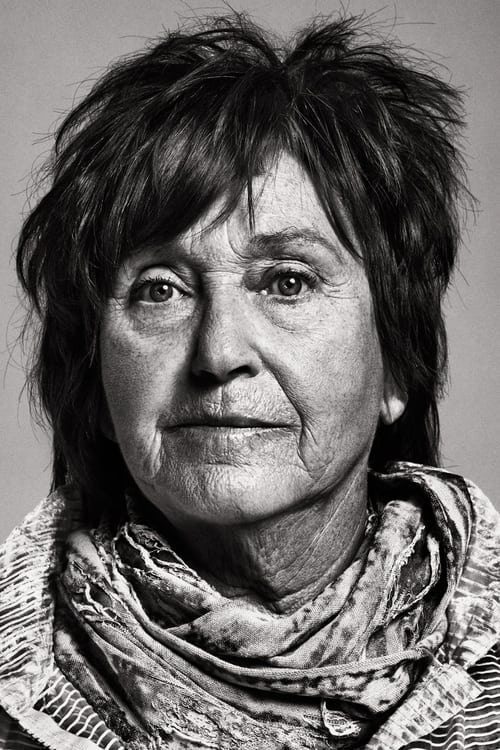
Valie Export
Biography
Valie Export (1940-2026), born Waltraud Lehner, was an Austrian artist. Her artistic work includes video installations, body performances, expanded cinema, computer animations, photography, sculptures and publications covering contemporary arts.
Known For & Full Filmography16 Titles

Movie - 2026, 2h 15m • as Self
From the starting point of her admiration for the pioneering Ukrainian filmmaker Kira Muratova (1934-2018), the director poses a question: is cinema made by women really tougher, more violent? Seeking answers, she talks to great contemporary filmmakers like Catherine Breillat, Virginie Despentes, Alice Diop, Céline Sciamma, Ana Lily Amirpour, and Monika Treut, among others. It becomes obvious that the cinema screen is a space for the projection of real social problems and power relations.

Movie - 1973, 2h 15m • Main Cast Role
“This film deals with exploring one´s surroundings by means of the body, and the exploration of the surrounding body. Not only is something shown in this film, showing itself is shown, not only is something portrayed, portrayal itself is portrayed. A sense of space is created in a way possible only with film: seeing oneself from the front and back simultaneously, from above and below, and from outside in the center of the space. The film combines opposite parts of the space, which form the body´s imperceptible time-space continuum. Space is carried along, just like the camera.” – VALIE EXPORT

Movie - 1973, 2h 15m • Main Cast Role
With sometimes painful directness, Valie Export conducts a psychological investigation of the body in this film performance, externalizes an internal state. In front of a police photo showing two children who were sexually abused by their parents, she tortuously cuts into her cuticles until blood drips into a bowl of milk on her lap. On top of the symbolic plane of blood and milk, the physical effect on the viewer of her destructive act of self-mutilation is extreme.

Movie - 1967, 2h 15m • Main Cast Role
Documentary and pseudo-documentary procedures were filmed simultaneously by two cameras from different viewpoints. The material was then divided into phases of movement. In the montage each phase was doubled. The techniques used in this process vary. Also the sound was doubled, again using different techniques. Two realities, differently perceived according to the conditions of this film, were edited into one synthetic reality, where everything is repeated. This doubling up destroys the postulate: identity of copy and image.

Movie - 1977, 2h 15m • as Self
This film is a kind of anthology about Vienna, from the invention of film to the present day. The aim is to break down the usual clichéd "image of Vienna" such as that found in the traditional "Vienna Film" by juxtaposing documentary footage, newly shot material and subjective sequences created by various artists. Individual, self-contained sections of the film gain new meaning within the context of historical material. Familiar sites appear estranged when edited together with historical scenes. Other scenes appear like a persiflage or satirical. The film does not incorporate any commentary whatsoever. It is a collage of diverse materials aimed at conveying a distanced image of Vienna to the viewer

Movie - 1989, 2h 15m • as Self
A comprehensive documentation of new art movements from 1945 to the present day. Beginning with the "Internationale Situationniste," "Cobra," "Spur," and "Wiener Gruppe" groups in Europe, and moving on to the international Happening and Fluxus movements, including the Viennese Actionists, and from 1970 onward to international Body and Performance Art, which also encompassed media art—film and video—the documentary presents film and photographic material from these art movements.

Movie - 1997, 2h 15m • as Self
Jonas Mekas assembles 160 portraits, appearances, and fleeting sketches of underground and independent filmmakers captured between 1955 and 1996. Fast-paced and archival in spirit, the film celebrates the avant-garde as its own “nation of cinema,” a vital community existing outside the dominance of commercial film.

Movie - 1984, 2h 15m • Main Cast Role
In her three-part series VALIE EXPORT takes a look at the themes of "staged space - staged time", "real movement - movable reality", and "structural film", a genre which no longer exists on public-service television. Using numerous examples from films prepared for the specific media, for example by Wojciek Bruszewski, Malcolm LeGrice, Sergey Eisenstein, Maya Deren, Kurt Kren, Yvonne Rainer, Anne Severson, Alfred Hitchcock, Linda Christanell, Gary Beydler and Marc Adrian, narrative and non-narrative forms of story-telling are examined and compared. Adrian appears in a live interview, and he attempts to explain the conditions of production, methods and Zeitgeist through his own work, including his first computer film, Random (1963). The advanced level of this film is also indicated by the high density of theoretical quotes from Christian Metz, Charles S. Peirce, Vsevolod I. Pudovkin and Ferdinand de Saussure.

Movie - 1981, 2h 15m • as Sister Helga
Baron Childerich III of Bartenbruch considers himself to be a descendant of the Merovingian dynasty and he has drawn up a chart of marriages and adoptions which show that he is his own father, grandfather, father-in-law, and son-in-law. He aims at achieving the "total family" based on one man. He persuades his french relative, Pippin, to help him. But the latter lets him down and breaks up the family... Among those who belong to the (surrounding) world of the Baron are Dr. Döblinger, a writer, who has formed a band of muggers and Professor Horn, a psychiatrist, who quiets his patients by leading them on nose rings and beating them up... Family satire with numerous personal and literary allusions based on the novel of the Austrian writer, Heimito von Doderer.

Movie - 1985, 2h 15m • Main Cast Role
Home movies shot on Super 8mm by W+B Hein over 10 years.

Movie - 2010, 2h 15m • as Performer
The starting point for this film is an eighteenth-century musical dice game attributed to Wolfgang Amadeus Mozart. A sequence of short, precomposed musical options are randomly selected through rolling dice and following a table of rules; these sequences are then patched together to create a new composition. Here we see one possible result of this chance procedure.

Movie - 1969, 2h 15m • Main Cast Role
The film is ‘shown’ in the dark. But the cinema has shrunk somewhat – only two hands fit inside it. To see (i.e. feel, touch) the film, the viewer (user) has to stretch his hands through the entrance to the cinema. Tap and Touch Cinema is an example of how re-interpretation can activate the public. Extract fom the documentary "Wiener Underground"

Movie - 1969, 2h 15m • as Performer
The subtitle of this merry performance is "An Action Text", indicating that the artist's introduction for the vaudeville number was an inflammatory impetus. Export provides precise instructions for the use of a wrapped box of chocolate-covered candy produced by the renowned Viennese company Hofbauer. However, she has not made an advertisement for them and their presentation, but instead, she extols the packqge and confection as a work of art. Severe degradation of the surviving tape further blurs our perceptions.

Movie - 1973, 2h 15m • Main Cast Role
Man & Woman & Animal shows a woman finding pleasure in herself, the whole film is a kind of assertion and affirmation of female sexuality and its independence from male values and pleasures... (Joana Kiernan)

Movie - 1980, 2h 15m • Main Cast Role
A work on the perception of space, where a video of a motionless figure in a room correlates four different camera positions with four different synthesized tones. We see the inert artist and how she calmly faces the cameras head-on. Six minute version.

Movie - 2015, 2h 15m • as Herself
She is the godmother of performance art. With her shocking public actions she created in the late 60s images that have burned into the general visual memory until today. The life and work of the Austrian artist Valie Export exemplify a development in art history in which women sought and found new ways and means of expression. Her work provides a feminist counterpart to the Viennese actionism of her time, which has influenced numerous artists of subsequent generations. The innovative diversity of her artistic approaches makes Valie Export an icon of 20th century art history.